
Care & cleaning guide
You are planning to purchase a Serge Lesage rug.
Our patterns, materials and textures will seduce you, as will the quality of our craftsmanship, which has always been recognized.
A Serge LESAGE rug is a true investment over time.
To preserve its shine and guarantee a long life, a few simple steps are all it takes.
Here are our care tips to ensure it retains all its freshness from the moment it's installed in your home.
The Serge Lesage rug is a handcrafted rug, entirely handmade.
It will always have some imperfections and irregularities in terms of height, direction of hair growth, or uniformity of color. This is what makes it unique and charming.
Upon unpacking, your rug will have creases and flattened fibers. This will all disappear once your rug has been laid flat on the floor for a few days in the open air.
To preserve the original beauty of your rug in general, avoid:
- placing it in a place that is too confined or particularly humid
- to always leave it in the same place, especially if it is a passageway; it is also recommended to periodically change its direction
- to remove dirt from a dusty rug: it is essential to vacuum first.
- to soak the carpe

Anti-stain treatment
We have selected the Texguard solution to offer you a stain-resistant treatment solution.
This treatment protects the surface of the carpet and makes it waterproof against water, oil and stains of various origins (coffee, wine, sodas, tea, etc.).
However, it is not a guarantee against all stains and stain removal may require the use of different products (see below).
The application of a Texguard product is done on request at the time of purchase of the carpet by our teams or by contacting a professional.
To maintain its effectiveness over time, the treatment must be repeated after each deep cleaning of the carpet

Shimmering
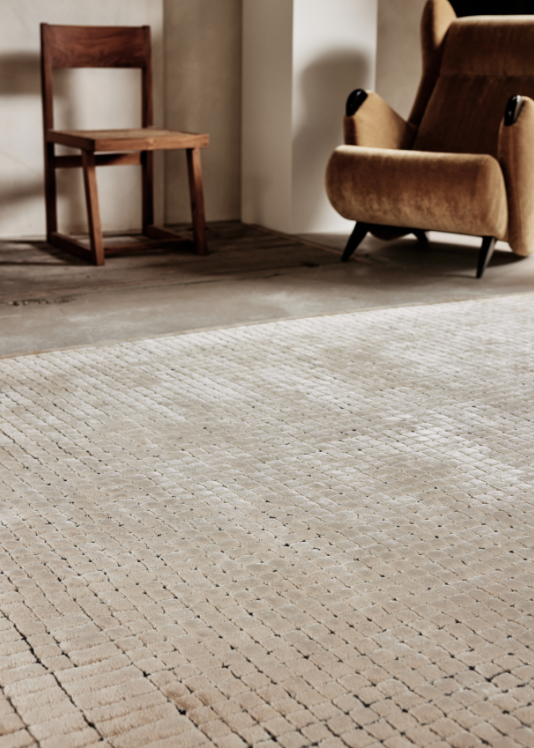
The phenomenon of shimmering (also called moiré, shading, or sometimes pile reversal) refers to a visible variation in color or sheen on a rug, depending on the viewing angle or the direction of the pile. It is not a stain or a manufacturing defect, but a natural optical phenomenon related to the reflection of light on the fibers.
This phenomenon is particularly noticeable on viscose or TencelTM carpets but can also appear on wool carpets.
It appears because the carpet fibers are never perfectly uniform. The way you vacuum will change the direction of the fibers and alter the areas of reflection.
It can sometimes be mitigated, but it never disappears completely.
To limit it:
- brush gently in the same direction (with a soft brush or a rubber broom);
- vacuuming in one direction only, without a rotating brush;
- rotate the mat regularly to balance visual wear;
- avoid high-traffic areas or sources of direct light (such as a bay window)

Break-in period
Wool carpets, and to a lesser extent TencelTM and viscose carpets, are prone to developing "pilling" at the beginning of their life.
This is perfectly normal and inherent to the nature of the material. This is what distinguishes a good quality rug.
During the first few months, short fibers will loosen and become visible on the surface of the rug. Don't worry about walking on your rug; the surface fluff will easily be removed with a vacuum cleaner. This shedding will disappear after a few months of use.
A loose thread may appear. This is excess thread that should be cut with scissors and definitely not by pulling on it

Dusting
Generalities
Perform this weekly using your vacuum cleaner, at normal power, brush position for wool carpets and without brush for viscose or TencelTM carpets and leather carpets.
Avoid unnecessary back-and-forth movements. This step shouldn't be neglected because dust, by settling deep within the carpet, suffocates the fibers, which, like all organic matter, need air to remain in good condition. Furthermore, a dirty carpet can become a haven for moths.
Choosing a vacuum cleaner
For maximum efficiency, use a vacuum cleaner with a special carpet attachment. If your vacuum cleaner has adjustable and rotating brushes, set them to the maximum height or turn them off to avoid damaging the fibers.
Do not use a steam cleaner or an industrial vacuum cleaner with excessive power. These will damage your carpet.
Also make sure your vacuum cleaner is properly maintained: undamaged head, clean brushes, accessories free of obstructions…
Vacuum in the direction of the nap to preserve the appearance and avoid breaking the fibers. Avoid rubbing or vigorously brushing.
Deep cleaning
At regular intervals, your rug will need a deep cleaning, a proper "wash," to restore its loft and original appearance. This cleaning, depending on usage, may be necessary every 1 to 3 years and depends on its composition.
Wool rug:
- Professional cleaning is the priority.
- It is possible to use a special dry wool cleaner such as dry foam or absorbent powder.
- It is also possible to clean it yourself with a small shampooer and soap.
Viscose or Tencel™ rug
- Cleaning by a qualified professional, experienced in handling viscose or plant fibers such as TencelTM.
- It will be able to use dry techniques such as encapsulation.
Carpets made of silk and plant fibers (sisal, jute, coconut, hemp…)
- Professional cleanin

Stain removal
Immediate actions
In case of an incident, intervene immediately, especially for viscose or TencelTM, which are delicate and very absorbent materials, starting by removing the excess, by dabbing with a white cloth or paper towel in the case of a liquid stain or a utensil for a solid stain (e.g., sauce, etc.).
Before using any stain removal product, test it first on an inconspicuous area.
Avoid rubbing to prevent damaging the carpet fibers and causing the stain to penetrate.
Always work from the outside in to the inside of the stain to avoid spreading it.

Stain removal
The methods described here apply to stains such as coffee, red wine, grease, or sauce. For other types of stains, please feel free to contact us (after removing the excess) by email ( contact@sergelesage.com ) or by the chat on the website www.sergelesage.com specifying the model of the rug and the origin of the stain.
For wool rugs:
Once the excess has been removed, here are the different steps to follow:
Step 1 — Absorb
- Blot immediately with a dry white cloth or absorbent paper
- Do not rub
- Remove as much liquid as possible
Step 2 — Localized Cleaning
- Use a pH-neutral textile cleaner specifically designed for wool (James range for example).
- Apply the product to a clean cloth
- Gently dab from the outside towards the center of the stain
- Repeat if necessary without soaking.
Step 3 — Light rinse (if needed)
- Dab with a slightly damp cloth (cold or lukewarm water).
- Do not over-wet
Step 4 — Drying
- Dab with a dry cloth
- Allow to air dry
- Avoid all direct heat

For rugs made of Tencel™, viscose, silk or bamboo
Never wet carpets containing any fiber other than wool.
Step 1 — Absorb
- Dab immediately with a dry white cloth or absorbent paper
- Do not rub
- Do not pour water directly
Step 2 — Localized Cleaning
- Use a very small amount of suitable textile cleaner (pH neutral type) (James range for example)
- Apply the product to the cloth, not directly onto the carpet.
- Gently dab from the outside towards the center of the stain
Step 3 — Drying
- Dab with a dry cloth
- Allow to air dry (upside down or hung up for viscose to avoid a halo effect)
- Avoid all sources of direct heat